Total Cost of Ownership Analysis
Real numbers comparing self-hosted infrastructure vs. cloud SaaS—with hybrid cloud strategies for maximum ROI.
Hybrid Cloud TCO: Startup vs. Enterprise Paths
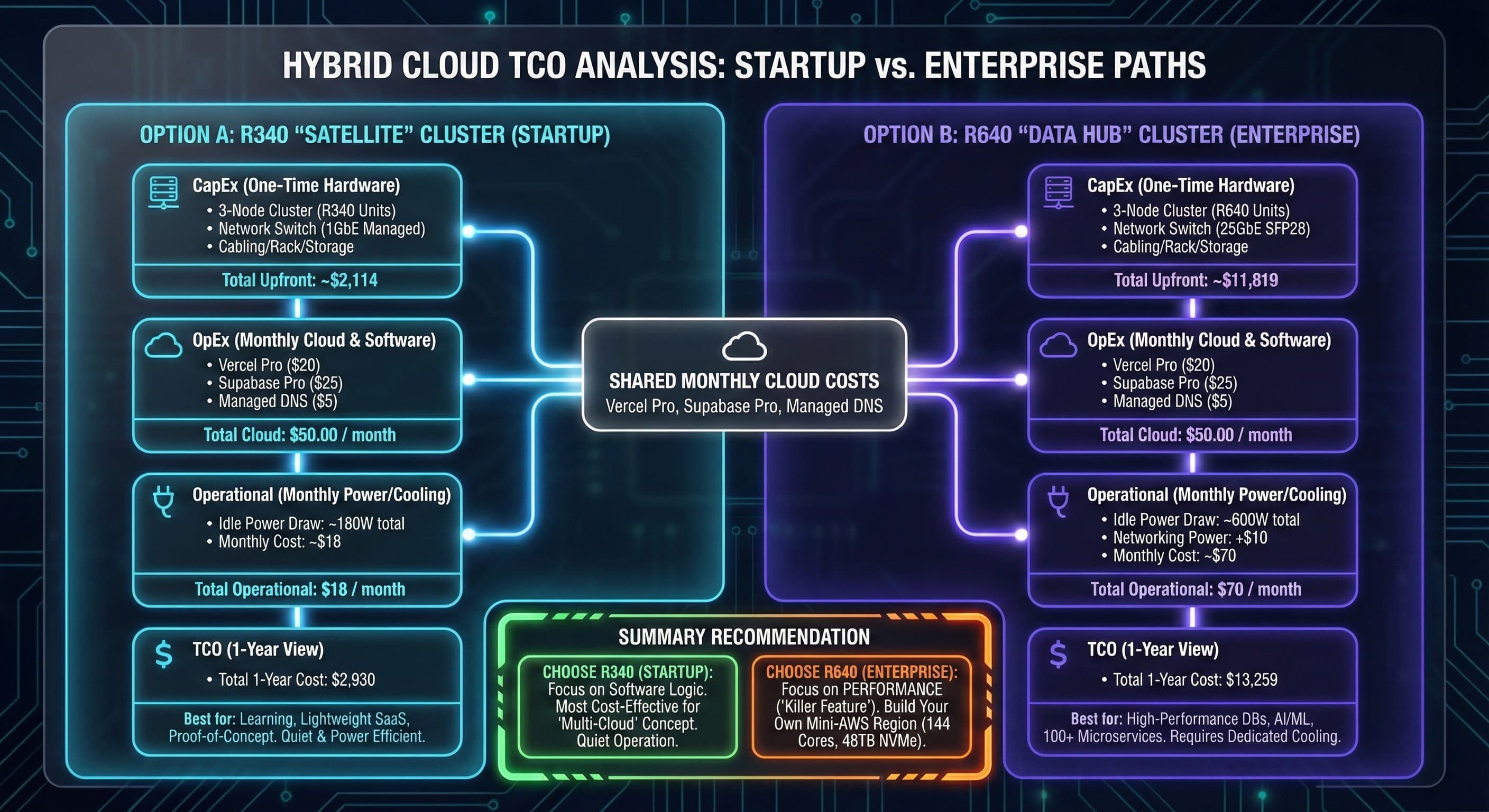
The hybrid cloud model gives you the best of both worlds: on-premise hardware for predictable base load, with cloud burst capacity for peak demands. This analysis shows 1-year TCO for two different business maturity levels.
Option A: R340 "Satellite" Cluster (Startup)
CapEx (One-Time Hardware)
OpEx (Monthly Cloud & Software)
Operational (Monthly Power/Cooling)
TCO (1-Year View)
Best For: Learning, Lightweight SaaS, Multi-Cloud Contexts
Ideal for startups testing self-hosting or teams with <100 workflows. Low upfront cost, easy to deploy, and perfect for proof-of-concept projects. Minimal database load, good for edge computing and distributed deployments.
Option B: R640 "Data Hub" Cluster (Enterprise)
CapEx (One-Time Hardware)
OpEx (Monthly Cloud & Software)
Operational (Monthly Power/Cooling)
TCO (1-Year View)
Best For: High-Performance Needs, AI/ML, Large-Scale SaaS (100+ Customers)
Enterprise-grade automation platform with massive parallel processing, NVMe storage density, and 25 Gbe networking. Ideal for customer-facing SaaS, data-intensive workloads, and teams running AI models. Built for modern Kubernetes environments with persistent tool memory.
Server TCO Comparison
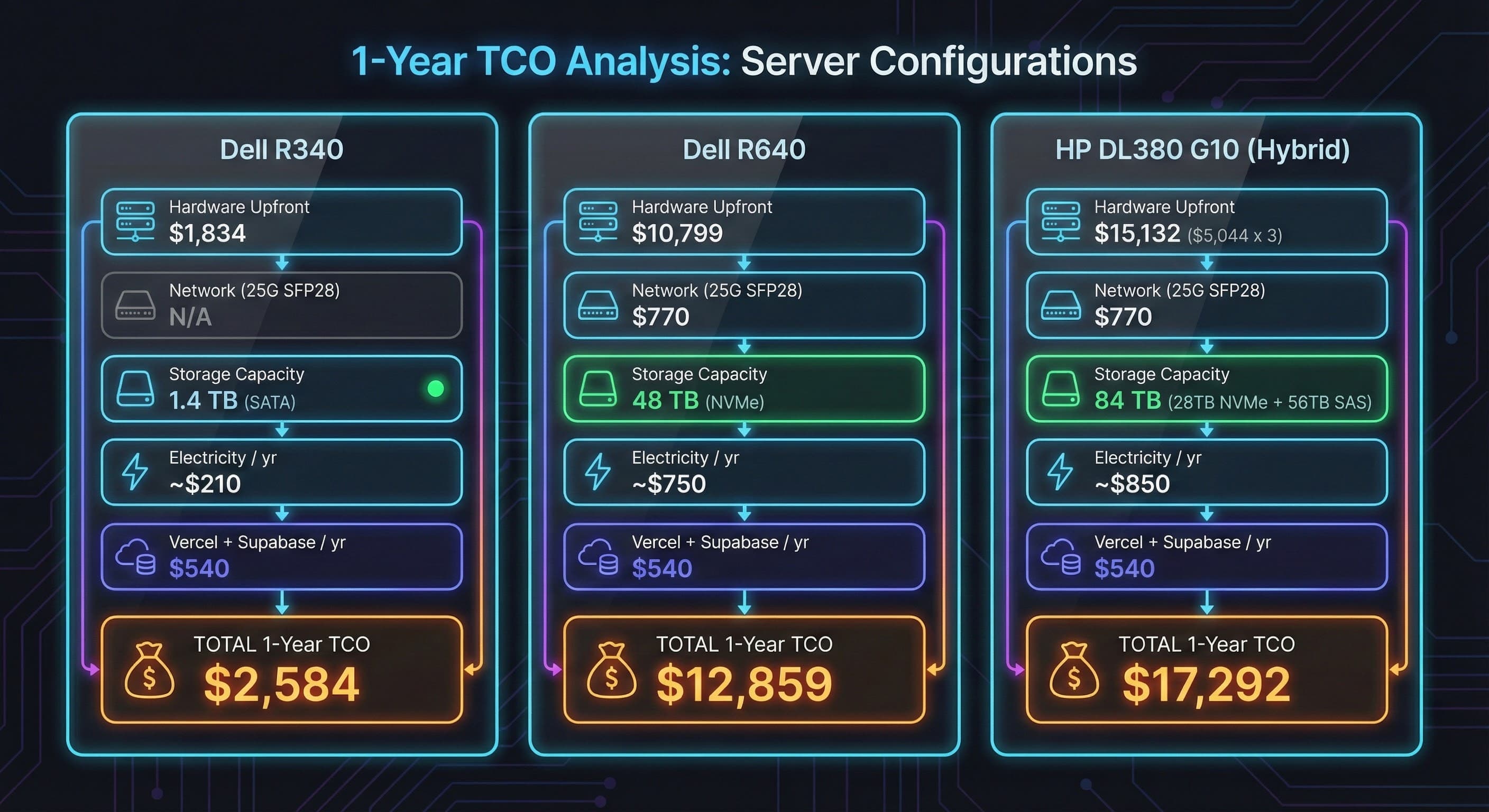
Side-by-side comparison of three infrastructure options: Dell R340, Dell R640, and HP DL380 G10 (hybrid). Each configuration includes hardware costs, networking, power/cooling, and managed services (Vercel + Supabase).
Shared Monthly Cloud Costs
All hybrid cloud configurations share the same monthly SaaS costs for managed services. This keeps operational complexity low while maintaining maximum flexibility.
Vercel Pro (SSG)
Static site generation, edge functions, analytics, and unlimited bandwidth
Supabase Pro (DB)
Managed PostgreSQL, real-time subscriptions, auth, storage APIs
Managed DNS
CloudFlare or AWS Route53 for global DNS with DDoS protection
ROI Breakeven Analysis
Key Insights
Hybrid Cloud = Best of Both Worlds
Self-host compute-heavy workloads (n8n, databases) on-premise for fixed costs, while using managed SaaS for stateless services (CDN, DNS, edge functions). This strategy minimizes operational overhead while controlling infrastructure spend.
Scale Economics Favor Self-Hosting
SaaS automation platforms charge per execution or per user. As your business grows, costs scale linearly. Self-hosted infrastructure has fixed upfront costs—the more you use it, the lower your per-workflow cost becomes.
R340 for Learning, R640 for Production
Start with R340 clusters to test self-hosting and migrate workflows from SaaS platforms. Once you validate the approach and need more performance, upgrade to R640 for enterprise scale. Hardware can be resold or repurposed—SaaS subscriptions are sunk costs.
Own Your Infrastructure, Own Your Destiny
Cloud providers can raise prices, deprecate features, or change terms of service. With owned hardware, you're not subject to arbitrary pricing changes or vendor lock-in. Your automation runs on infrastructure you control.
Get Your Custom TCO Analysis
Every business has different automation needs, growth trajectories, and cost structures. Schedule a Logic Audit and we'll build a custom TCO model comparing SaaS, cloud, and self-hosted options for your specific workload. We'll show you the break-even point and 3-year ROI projections.
Schedule Your Logic Audit